Library of Formatting Examples:Signatures/00A
Jump to navigation
Jump to search
| Distributed Proofreaders: Activity Hub · Wiki · Forums · Blog | ||
| << (Signatures) | Library of Formatting Examples Signatures |
(Signatures/01A) >> |
Page image

Correctly formatted text
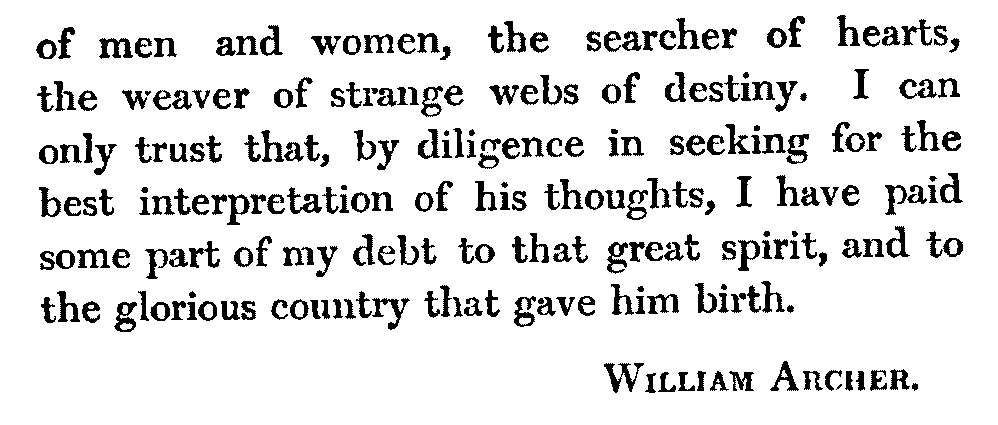
of men and women, the searcher of hearts,
the weaver of strange webs of destiny. I can
only trust that, by diligence in seeking for the
best interpretation of his thoughts, I have paid
some part of my debt to that great spirit, and to
the glorious country that gave him birth.

[** Right-justified, so enclose in no-wrap.]
/*
[** Small-caps, with period inside.]
<sc>William Archer.</sc>
*/
Overview of signatures
Signatures occur in many contexts: letters, Prefaces (such as this example), dedications, citations, and as attributions at the end of poetry or verse.
- Left-justify them, even if they are indented or right-aligned in the Image.
- They almost always need to be enclosed in no-wrap, because they're usually indented, but not the way paragraphs are indented.
- When there is a "complimentary closing" (e.g., "Y'r obedient servant," or dates, all of those lines usually can go in the same pair of no-wraps.
- When they are on the same line as the "closing," move the signature to a line of its own, possibly even leaving a blank line between them.
- If a signature is in small-caps (or italics), mark it that way. If there's also a period after it, determine whether the signature is part of a "sentence" or is its own "sentence." In practice, this means looking at what precedes it to see whether there's a comma or a period. If the preceding punctuation is a period, then the period after the signature goes inside the in-line markup; if the preceding punctuation is a comma, then the period after the signature belongs to the overall "sentence" and the period goes outside the in-line markup.