Library of Formatting Examples:Italics/36B: Difference between revisions
Jump to navigation
Jump to search
No edit summary Tag: Reverted |
No edit summary Tag: Manual revert |
||
| Line 1: | Line 1: | ||
{{LOFE:Navbar|prev=Italics/36A|next=Italics/37B|cat=Italics}} | {{LOFE:Navbar|prev=Italics/36A|next=Italics/37B|cat=Italics}} | ||
{{LOFE:Example start |image-filename=101-36B.png|iw= | {{LOFE:Example start |image-filename=101-36B.png|iw=20|tw=45}} | ||
{{LOFE:Blank}} | {{LOFE:Blank}} | ||
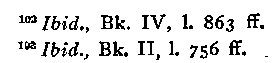
[Footnote 102: {{LOFE:Tag|i}}Ibid.{{LOFE:Tag|/i}}, Bk. IV, l. 863 ff.] | [Footnote 102: {{LOFE:Tag|i}}Ibid.{{LOFE:Tag|/i}}, Bk. IV, l. 863 ff.] | ||
Revision as of 08:35, 9 November 2025
| Distributed Proofreaders: Activity Hub · Wiki · Forums · Blog | ||
| << (Italics/36A) | Library of Formatting Examples Italics |
(Italics/37B) >> |
Page image

Correctly formatted text
[blank line]
[Footnote 102: <i>Ibid.</i>, Bk. IV, l. 863 ff.]
[blank line]
[Footnote 103: <i>Ibid.</i>, Bk. II, l. 756 ff.]
Abbreviations and footnotes
"Ibid." is an abbreviation. Period goes inside the markups. The commas go outside. Italicized abbreviations are common in footnotes, and because they're printed in a smaller font, often are harder to find. So, treat footnotes like contracts, and "carefully read the fine print." (Quickly scanning for breaks in the pattern just won't work with fine print.) And, while on the subject of Footnotes, they often contain stealth small-cap Roman Numerals (this example does not). Equally often, they contain lower-case Roman Numerals that should not be marked, but it can be very hard to tell the difference.