Library of Formatting Examples:Index/00A: Difference between revisions
Jump to navigation
Jump to search
m (Chapka moved page Library of Formatting Examples:Index/00A to Library of Formatting Examples:Indexes/00A without leaving a redirect) |
m (Chapka moved page Library of Formatting Examples:Indexes/00A to Library of Formatting Examples:Index/00A without leaving a redirect) |
(No difference)
| |
Revision as of 09:36, 10 December 2025
| Distributed Proofreaders: Activity Hub · Wiki · Forums · Blog | ||
| << (Index) | Library of Formatting Examples Index |
(Index/01A) >> |
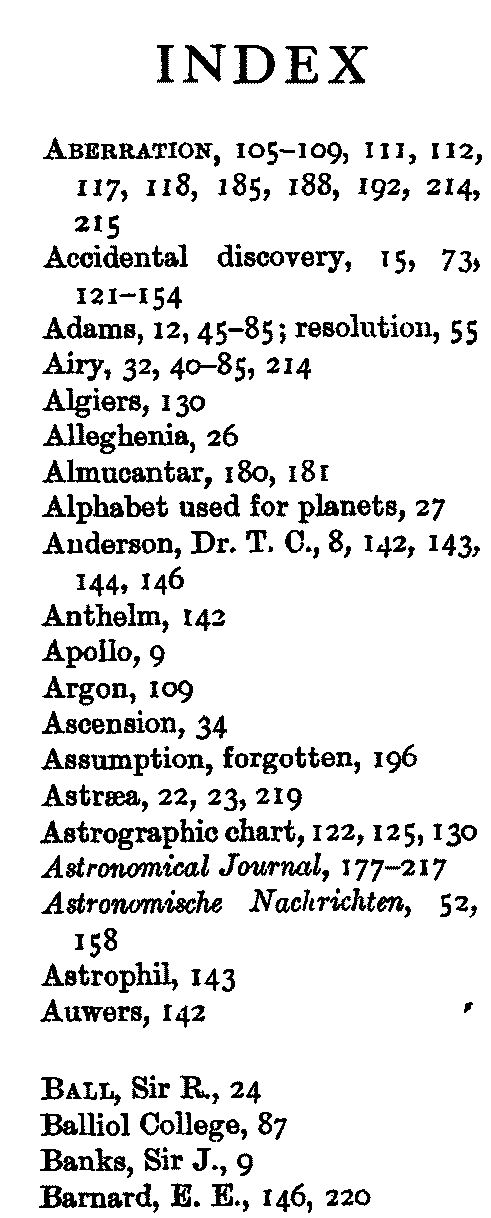
Page image

Correctly formatted text
[blank line]
[blank line]
[blank line]
[blank line]
INDEX
[blank line]
[blank line]
/*
Aberration, 105-109, 111, 112, 117, 118, 185, 188, 192, 214, 215

Accidental discovery, 15, 73, 121-154

Adams, 12, 45-85;[** Primary entry]
  resolution, 55 [** Sub-entry]

Airy, 32, 40-85, 214

Algiers, 130

Alleghenia, 26

Almucantar, 180, 181

Alphabet used for planets, 27

Anderson, Dr. T. C., 8, 142, 143, 144, 146

Anthelm, 142

Apollo, 9

Argon, 109

Ascension, 34

Assumption, forgotten, 196

Astræa, 22, 23, 219

Astrographic chart, 122, 125, 130

<i>Astronomical Journal</i>, 177-217

<i>Astronomische Nachrichten</i>, 52, 158

Astrophil, 143

Auwers, 142


Ball, Sir R., 24[** New letter equals new section.]

Balliol College, 87

Banks, Sir J., 9

Barnard, E. E., 146, 220
*/
Overview of indexes
An index is a major division, so use 4/2 spacing. Enclose all of it except the heading ("INDEX") in no-wrap.
If an entry takes up more than one line, unwrap it onto a single line.
Leave a blank line between each primary entry; start each sub-entry on a new line, and indent sub-entries by 2 spaces, single-spaced.
A new letter equals a new section; precede it by 2 blank lines.