Library of Formatting Examples:Lists/04A: Difference between revisions
Jump to navigation
Jump to search
No edit summary |
No edit summary Tag: Reverted |
||
| Line 44: | Line 44: | ||
{{LOFE:Example end}} | {{LOFE:Example end}} | ||
[[Category:LOFE Shared images]] | |||
Revision as of 13:23, 19 December 2025
| Distributed Proofreaders: Activity Hub · Wiki · Forums · Blog | ||
| << (Lists/03A) | Library of Formatting Examples Lists |
(Chapters) >> |
Page image

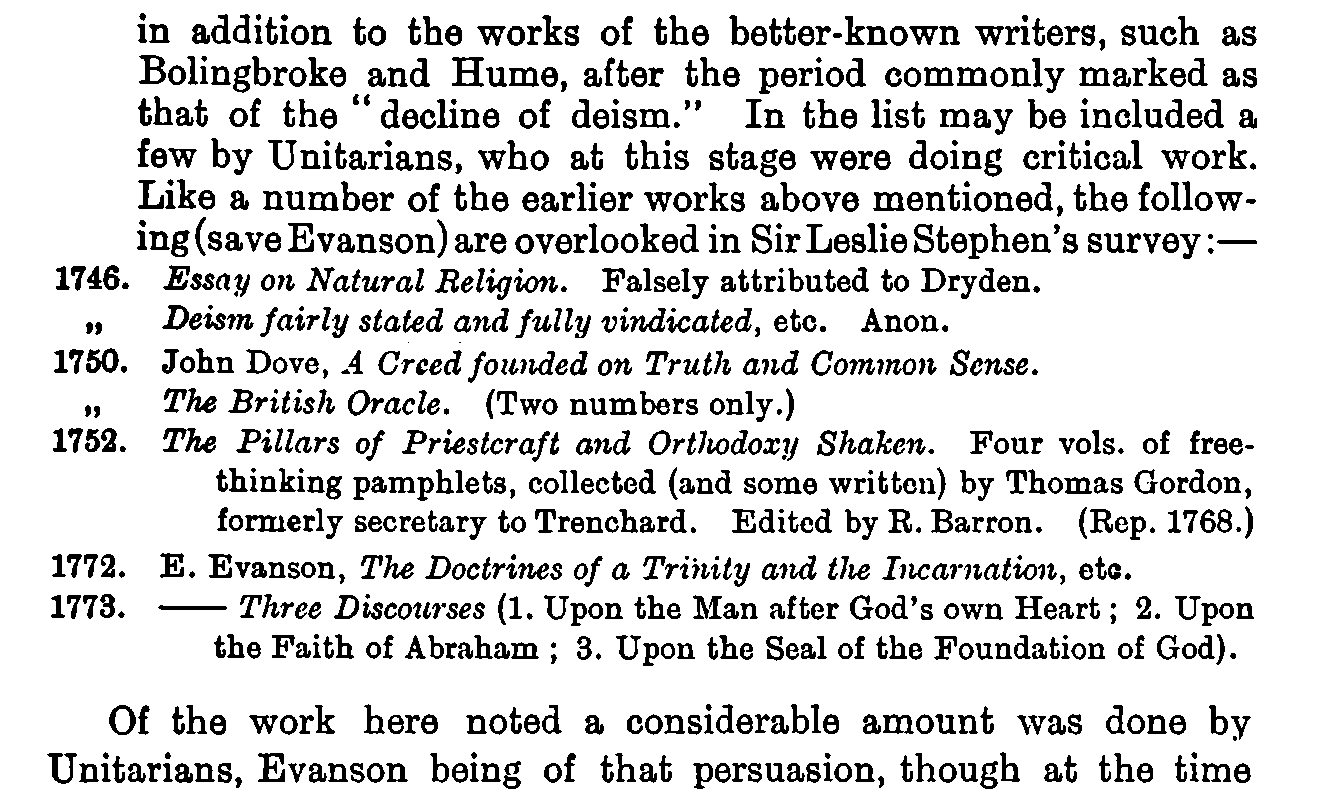
Correctly formatted text
/#
in addition to the works of the better-known writers, such as
Bolingbroke and Hume, after the period commonly marked as
that of the "decline of deism." In the list may be included a
few by Unitarians, who at this stage were doing critical work.
Like a number of the earlier works above mentioned, the following
(save Evanson) are overlooked in Sir Leslie Stephen's survey:--

/*
1746.  <i>Essay on Natural Religion.</i> Falsely attributed to Dryden.

  "    <i>Deism fairly stated and fully vindicated</i>, etc. Anon.

1750.  John Dove, <i>A Creed founded on Truth and Common Sense</i>.

  "    <i>The British Oracle.</i> (Two numbers only.)

1752.  <i>The Pillars of Priestcraft and Orthodoxy Shaken.</i> Four vols. of freethinking
         pamphlets, collected (and some written) by Thomas Gordon,
         formerly secretary to Trenchard. Edited by R. Barron. (Rep. 1768.)

1772.  E. Evanson, <i>The Doctrines of a Trinity and the Incarnation</i>, etc.

1773.  ---- <i>Three Discourses</i> (1. Upon the Man after God's own Heart; 2. Upon
         the Faith of Abraham; 3. Upon the Seal of the Foundation of God).
*/
#/

Of the work here noted a considerable amount was done by
Unitarians, Evanson being of that persuasion, though at the time
A two-column table
This is a two-column table. It can't be formatted as a simple list, because some of the entries are multi-line with hanging indents, and the ditto marks must be associated with the dates. The mdash above it, and the extra space below it, confirm that it's part of the Block Quote. This example also appears in the "Tables" category.
Block quotes
The paragraph at the top of the page is indented and wrappable, so it's a Block Quote. After the table, the paragraph is no longer indented, so Block Quote ended above