Library of Formatting Examples:Italics/06A: Difference between revisions
Jump to navigation
Jump to search
No edit summary |
|||
| Line 14: | Line 14: | ||
{{LOFE:Tag|i}}ore expectant{{LOFE:Tag|/i}} and {{LOFE:Tag|i}}possible ore{{LOFE:Tag|/i}}. | {{LOFE:Tag|i}}ore expectant{{LOFE:Tag|/i}} and {{LOFE:Tag|i}}possible ore{{LOFE:Tag|/i}}. | ||
{{LOFE:Example middle}} | {{LOFE:Example middle}} | ||
== | == Lists == | ||
This example includes a simple in-line list. Mark each "item" in the list separately. The comma and the 'or' are not items in list, and go '''outside''' the markups. | This example includes a simple in-line list. Mark each "item" in the list separately. The comma and the 'or' are not items in list, and go '''outside''' the markups. | ||
Revision as of 04:59, 3 October 2025
| Distributed Proofreaders: Activity Hub · Wiki · Forums · Blog | ||
| << (Italics/05A) | Library of Formatting Examples Italics |
(Italics/07A) >> |
Page image

Correctly formatted text
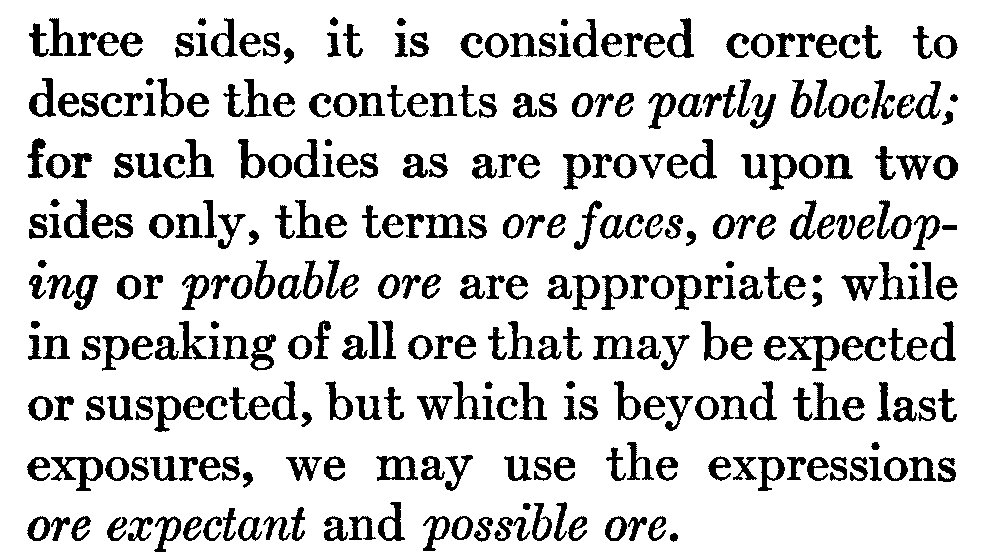
   three sides, it is considered correct to
   describe the contents as <i>ore partly blocked</i>;
   [** semi-colon goes OUTSIDE.]
   for such bodies as are proved upon two
   [** Below, a simple list; mark each item separately.]
   sides only, the terms <i>ore faces</i>, <i>ore developing</i>
   or <i>probable ore</i> are appropriate; while
   in speaking of all ore that may be expected
   or suspected, but which is beyond the last
   exposures, we may use the expressions
   <i>ore expectant</i> and <i>possible ore</i>.
Lists
This example includes a simple in-line list. Mark each "item" in the list separately. The comma and the 'or' are not items in list, and go outside the markups.
Non-italicized words in between italics
it's easy to miss an upright word in the middle of two italicized words, like the "and" in the last line of this example.