Library of Formatting Examples:Italics/50A: Difference between revisions
Jump to navigation
Jump to search
(Created page with "{{LOFE:Navbar|prev=Italics/49A|next=Italics/51A|cat=Italics}} {{LOFE:Example start |image-filename=101-50A.png|iw=35|tw=60}} The plural number, and the genitive singular, seem to have been originally formed by adding {{LOFE:Tag|i}}er{{LOFE:Tag|/i}} to the nominative singular, as {{LOFE:Tag|i}}you, you-er, your{{LOFE:Tag|/i}}; {{LOFE:Tag|i}}they, they-er, their{{LOFE:Tag|/i}}; {{LOFE:Tag|i}}we, we-er, our{{LOFE:Tag|/i}}. This termination was afterwards changed into {{...") |
No edit summary |
||
| Line 1: | Line 1: | ||
{{LOFE:Navbar|prev=Italics/49A|next=Italics/51A|cat=Italics}} | {{LOFE:Navbar|prev=Italics/49A|next=Italics/51A|cat=Italics}} | ||
{{LOFE:Example start |image-filename=101-50A.png|iw= | {{LOFE:Example start |image-filename=101-50A.png|iw=45|tw=60}} | ||
The plural number, and the genitive singular, seem to have been | The plural number, and the genitive singular, seem to have been | ||
originally formed by adding {{LOFE:Tag|i}}er{{LOFE:Tag|/i}} to the nominative singular, as {{LOFE:Tag|i}}you, you-er, | originally formed by adding {{LOFE:Tag|i}}er{{LOFE:Tag|/i}} to the nominative singular, as {{LOFE:Tag|i}}you, you-er, | ||
Latest revision as of 03:01, 28 December 2025
| Distributed Proofreaders: Activity Hub · Wiki · Forums · Blog | ||
| << (Italics/49A) | Library of Formatting Examples Italics |
(Italics/51A) >> |
Page image

Correctly formatted text
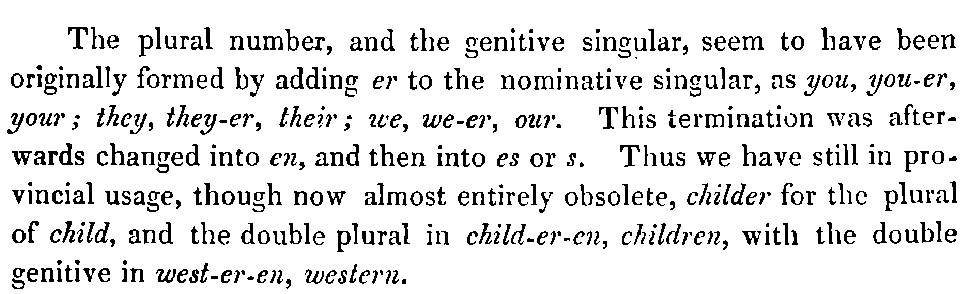
The plural number, and the genitive singular, seem to have been
originally formed by adding <i>er</i> to the nominative singular, as <i>you, you-er,
your</i>; <i>they, they-er, their</i>; <i>we, we-er, our</i>. This termination was afterwards
changed into <i>en</i>, and then into <i>es</i> or <i>s</i>. Thus we have still in provincial
usage, though now almost entirely obsolete, <i>childer</i> for the plural
of <i>child</i>, and the double plural in <i>child-er-en, children</i>, with the double
genitive in <i>west-er-en, western</i>.
Lists
These are unusual inline lists: the author seems to be emphasizing groups of variants, rather than individual words, so we enclosed each group, rather than each word, in a single set of italics tags. The group delimiters are semi-colons, not commas.
When you see unusual situations, it's always a good idea to ASK about them in the Project Discussion, and perhaps to leave a [** note].